
The health of a workforce has always been tied to the health of a business. Yet in 2025, employers face unprecedented pressure: rising insurance premiums, chronic-disease prevalence, and productivity losses.
The Business Group on Health 2024 Survey projects that employer medical costs will rise another 6–7% annually, largely due to preventable conditions such as diabetes, hypertension, and mental-health disorders to know ROI of precision medicine for employees.
Forward-thinking organizations are responding with precision medicine, an approach that personalizes prevention and treatment through genomic data, biomarkers, and advanced analytics. Instead of relying on broad wellness initiatives, employers can now offer health insurance plans that provide these advanced benefits, identifying risks earlier, guiding employees toward effective care, and delivering measurable financial returns.
For companies working with experienced health-benefits brokers such as IQ Financial Group, precision-based plans integrate seamlessly with existing insurance, delivering measurable savings, improving employee engagement, and enhancing coverage and benefits. The result: lower medical claims, stronger retention, and sustainable cost control.
This article explores how precision medicine delivers measurable ROI in employee wellness, explaining how preventative health analytics, personalized care models, and concierge-style virtual services are transforming workplace benefits.
It also outlines the framework employers can use to evaluate ROI, monitor outcomes, and turn employee wellness into a long-term business strategy.
What is Precision Medicine & Its Workplace Impact?
Precision medicine uses individualized health data, genetic markers, lifestyle information, and environmental factors to tailor medical care. Within an employer context, it shifts healthcare from reactive to preventative.
Modern analytics platforms analyze claims, biometrics, and population trends to detect early disease indicators. Employees receive targeted recommendations through digital health platforms, customized wellness guidance, and physician-led preventative interventions.
For employers, the impact is two-fold:
- Clinical accuracy, high-risk employees receive evidence-based interventions before chronic conditions develop.
- With financial clarity, the company can quantify avoided claims and productivity gains, transforming health benefits from a cost center into a performance asset.
Studies from Harvard Business Review and McKinsey & Company show that organizations adopting personalized-care models can reduce overall healthcare spending by 15–25% while improving job-satisfaction scores by up to 30%.
When integrated through brokers like IQ Financial Group, precision-based benefit options also leverage existing group health or supplemental insurance frameworks to ensure compliance, data security, and long-term scalability. Employers in Arizona especially benefit from these strategies, as the state’s proactive healthcare infrastructure supports rapid implementation and measurable ROI.
How Traditional Employee Wellness Programs Generate ROI
Traditional wellness programs paved the way for measurable health investment, yet they often stop at participation metrics. Step challenges and gym reimbursements encourage engagement, but they rarely address the biological root causes of disease.
Research in the American Journal of Health Promotion found that comprehensive wellness initiatives save an average of $3.27 in medical costs and $2.73 in absenteeism for every dollar spent. However, when these programs incorporate personalized screening and data analytics, ROI can double within two years.
| Value Driver | Traditional Model | Enhanced Precision Approach |
| Cost Control | Focuses on reactive treatment | Uses biomarker and claims analytics to predict and prevent high-cost cases |
| Employee Engagement | Generic fitness or stress programs | Personalized health plans increase sustained participation |
| Productivity | Measures attendance only | Integrates cognitive and metabolic data to track true performance impact |
| Retention | Broad corporate wellness culture | Tailored benefits enhance loyalty and recruitment appeal |
Employers adopting precision-enabled wellness frameworks report higher measurable outcomes, reduced emergency visits, improved chronic-condition management, and greater morale, all of which drive tangible ROI.
Personalized Preventive Care: The Precision Wellness Engine
At the core of precision medicine is preventative care powered by analytics. Instead of waiting for illness to occur, preventative models use health data to anticipate risks. AI-driven systems evaluate medical histories, prescription use, and lifestyle metrics to match each employee with the most clinically and cost-effective care options.
This process identifies trends such as rising cholesterol or inflammatory markers months before symptoms appear. Employees receive early lifestyle coaching or clinical referrals, while employers avoid expensive claims.
From a financial standpoint, precision-based wellness programs often integrate with pre-tax benefit structures authorized under Section 125 of the Internal Revenue Code. This allows employees to fund benefits with pre-tax dollars, frequently increasing take-home pay while enabling employers to save on payroll taxes.
These programs encourage smarter healthcare engagement by helping employees access preventative screenings and early-detection services that reduce long-term medical costs and strengthen workforce well-being.
It’s a rare win-win: improved health outcomes, measurable savings, and enhanced employee satisfaction, all within existing insurance infrastructure.
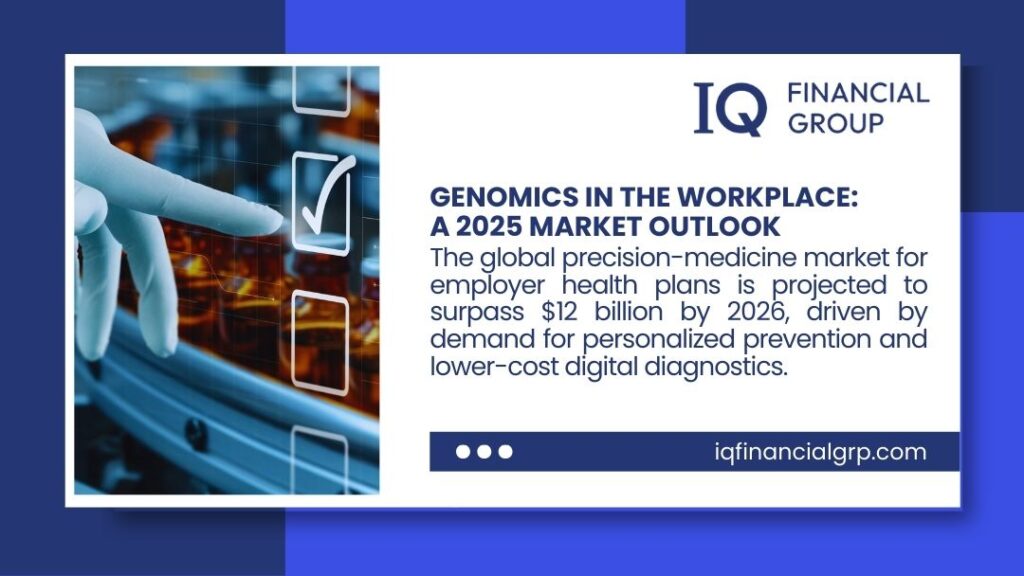
Real-World Impact: When Precision Meets Productivity
Evidence of measurable ROI is growing rapidly.
- A regional logistics company using personalized health analytics reported a 23% reduction in preventable claims and a 2.7:1 ROI within 18 months.
- A financial-services employer combining targeted preventative testing with concierge-style virtual care lowered absenteeism by 12% and boosted retention by 15%.
- Across 10,000 employees in manufacturing and technology sectors, early-risk intervention programs produced average healthcare savings of $1,400 per participant per year, according to Health Affairs 2024.
| Measured Benefit | Typical Outcome Range | Primary Business Impact |
| Reduction in high-cost claims | 18–25 % | Direct savings on insurance premiums |
| Absenteeism decrease | 10–15 % | Productivity and morale improvement |
| Employee participation | 70–85 % | Cultural adoption and retention |
| ROI ratio | 2:1 – 4:1 | Verifiable fiscal return on health investment |
These figures illustrate that precision-driven health management isn’t theoretical; it’s already reshaping cost structures and workplace performance.
Framework for ROI of Precision Medicine for Employees
A structured evaluation model helps employers prove the financial value of precision wellness initiatives. IQ Financial Group typically advises organizations to measure progress in four phases:
| Phase | Objective | Core Metrics | ROI Focus |
| 1 – Baseline Assessment | Establish current healthcare spend and health-risk distribution | Claims history, absenteeism, and biometric screening data | Defines the starting point for cost modeling |
| 2 – Implementation | Integrate personalized prevention and analytics platforms | Enrollment, participation, and early-intervention rates | Short-term engagement impact |
| 3 – Measurement & Mapping | Quantify claim reduction and productivity gain | Health-care cost per employee, presenteeism index | Demonstrates fiscal improvement |
| 4 – Continuous Optimization | Refine programs annually based on new data | Updated risk segmentation, trend analysis | Sustains 2–4× return over 3 years |
Employers that follow this framework typically begin seeing measurable financial improvement within the first year. On average, organizations experience a 15% decrease in monthly healthcare costs shortly after implementing this model.
Depending on first-year claims performance, employers may also be eligible for up to a 50% return of the claims expectation portion of their initial plan cost. As precision and preventative measures strengthen over time, ROI growth continues steadily through the second year and beyond.
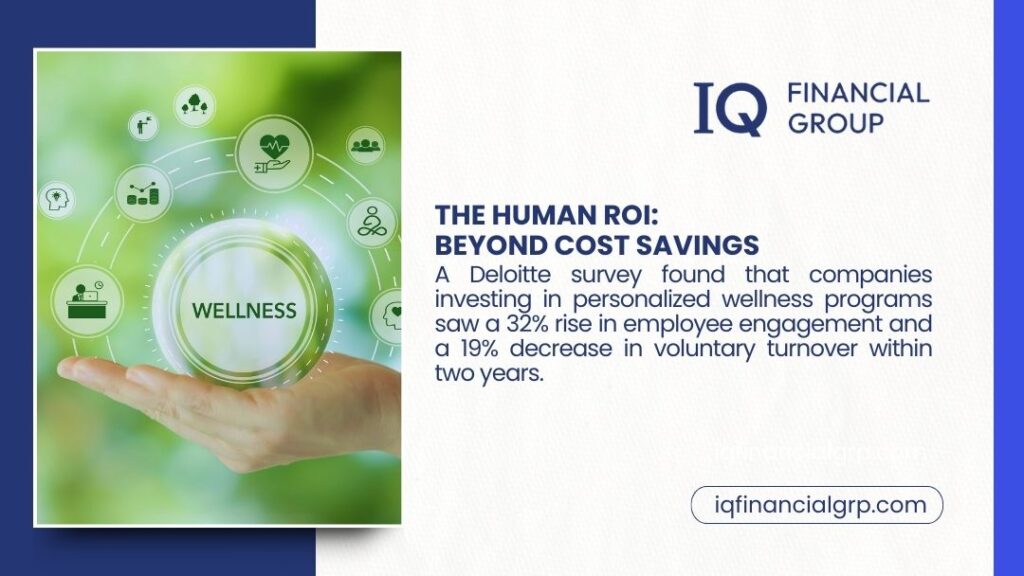
Key Metrics and Monitoring Success
Precision-driven wellness relies on transparency and data integrity. Success is tracked through a blend of medical, financial, and behavioral metrics:
| Category | Indicator | Measurement Method |
| Clinical Improvement | Decrease in chronic-risk markers | Biometric screenings & follow-up labs |
| Financial Savings | Reduced claim frequency & cost | Health-plan utilization reports |
| Workforce Engagement | Program participation & satisfaction | Quarterly employee surveys |
| Operational Efficiency | Decline in absenteeism/presenteeism | HR analytics dashboards |
| Cultural Impact | Retention & recruitment lift | Annual workforce review |
Monitoring these KPIs allows employers to tie wellness investments directly to business outcomes, a key advantage over traditional health programs.
In fact, with so few employers currently offering this type of precision-driven plan, adopting it not only enhances financial and health outcomes but also positions the organization as a standout employer in a competitive job market, strengthening both recruitment and retention efforts.
Challenges and Strategic Considerations
Implementing precision wellness requires alignment between HR, finance, and compliance teams. Employers must ensure adherence to HIPAA, GINA, and other data-protection standards when managing genetic or biometric information. Working through experienced health-insurance brokers ensures that all data sharing remains secure and legally compliant.
Another consideration is employee education. Clear communication about data privacy, clinical accuracy, and personal benefit helps build trust. Organizations that invest in transparent onboarding achieve higher participation rates and faster ROI.
Finally, integration across insurance, concierge virtual care, and analytics systems is crucial. Partnering with brokers who coordinate these components allows companies to streamline administration and maintain unified reporting on both health outcomes and cost savings.
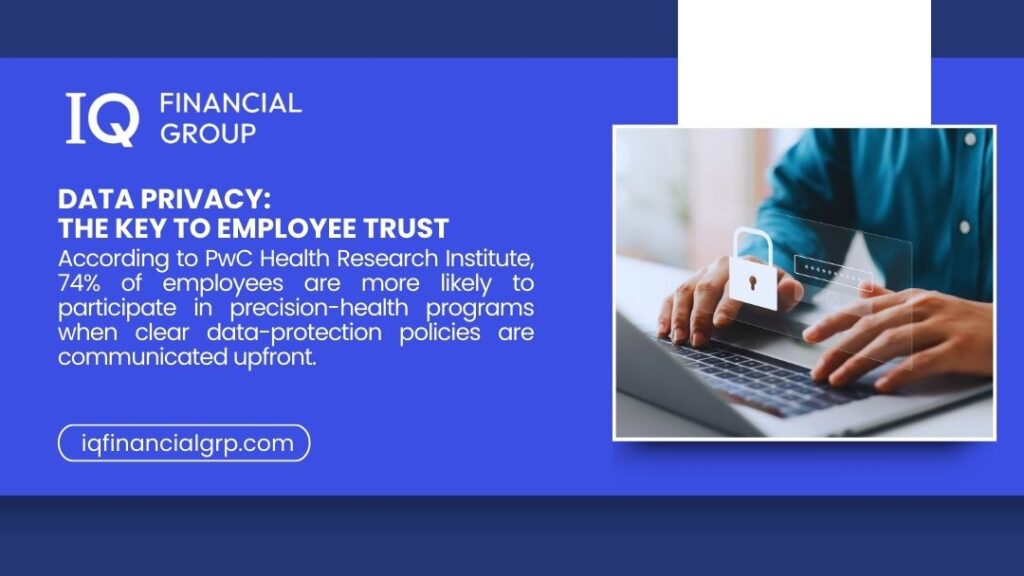
Turning Prevention Into a Business Strategy
Precision medicine is rapidly becoming the foundation of modern employee benefits. By combining personalized prevention, preventative analytics, and continuous concierge-style virtual care, employers can simultaneously improve lives and stabilize long-term costs.
Organizations that partner with seasoned advisors gain the additional advantage of compliance support, benefit-plan coordination, and tailored ROI tracking.
To understand the benefits of personalized medicine for employees and how it can enhance your organization’s health strategy, explore IQ Financial Group’s insights on the future of personalized medicine for employees.
Employers can also request a complimentary ROI Analysis Report through the consultation page to see precisely how data-driven wellness can reduce claims, enhance retention, and improve overall workforce health. It’s time to turn employee wellness into a strategic advantage, where better care drives better business.
